Deploying an AI chatbot on your website is no longer a futuristic experiment reserved for Silicon Valley startups. From customer support widgets that answer queries at 3 AM to lead-qualification agents that triage visitors before routing them to a human sales rep, conversational AI is rapidly becoming a standard feature of modern websites. But behind every fluid, helpful chatbot interaction lies a hosting infrastructure stack that most website owners never see—and that, when misconfigured or under-provisioned, silently degrades response quality, spikes latency, and inflates hosting bills beyond what the chatbot itself is worth. Understanding server requirements for AI chatbots is not a niche DevOps concern; it is the difference between a chatbot that impresses your visitors and one that frustrates them while draining your hosting budget.
The hosting requirements for AI chatbots span four interconnected layers: the frontend widget that renders in your visitor's browser, the backend API server that orchestrates logic and manages conversation state, the large language model integration that generates responses (either via an external API or a self-hosted inference engine), and—for knowledgeable chatbots that can reference your products and documentation—a vector database that performs semantic search over your content library. Each layer imposes distinct CPU, RAM, storage, and networking demands, and the relationship between these layers is multiplicative under concurrency: a chatbot that works perfectly for five simultaneous users can collapse under fifty if the hosting stack is not sized for the way real users interact. At Hosting Captain, we have benchmarked hosting for AI chatbot deployments across every major cloud and bare-metal provider, and the findings consistently point to the same conclusion: the most expensive hosting mistake in conversational AI is not selecting the wrong provider—it is underestimating concurrency and memory pressure before the first real user types "hello."
This guide maps the entire hosting stack for AI chatbots, from the commodity-tier shared hosting that can support simple rule-based widgets to the GPU-accelerated infrastructure that self-hosted large language models demand. You will find concrete server specifications by chatbot complexity tier, a direct cost comparison between API-dependent and self-hosted LLM architectures, a latency budget breakdown that explains why geographic hosting location matters more for chatbots than for regular web pages, and a scaling playbook that prevents your hosting costs from multiplying every time your chatbot gets popular. Whether you are embedding a lightweight FAQ bot into a portfolio site or building a retrieval-augmented customer support agent for a SaaS platform, the hosting decisions made before the first line of chatbot code goes live will define your operational costs for years. For foundational context on the hardware and software ecosystems that power intelligent websites, our guide to AI hosting covers GPU servers, inference-versus-training distinctions, and the broader infrastructure shift toward AI-native data centers that underpin everything discussed below.
The Four-Layer Chatbot Hosting Architecture
Every AI chatbot deployed on a website—regardless of whether it uses OpenAI's API, a self-hosted Llama model, or a simple keyword-matching engine—consists of four architectural layers, each of which imposes distinct hosting requirements. Understanding these layers as separate concerns is the first step toward provisioning the right infrastructure at the right price, because the most common hosting misconfiguration we see at Hosting Captain is collapsing all four layers onto a single server that was only sized for one of them.
The frontend widget layer runs in the user's browser and is responsible for rendering the chat interface, managing the WebSocket or HTTP connection to the backend, and streaming responses token-by-token for a ChatGPT-like typing effect. From a hosting perspective, the frontend is the cheapest layer—static JavaScript, CSS, and a small chat icon image served from a CDN at negligible bandwidth cost. However, the frontend's connection behavior dictates the backend's hosting requirements: if the widget opens a persistent WebSocket for every active chat session, your backend server must maintain that many concurrent connections, each consuming file descriptors, RAM for socket buffers, and CPU for keep-alive processing. A site with 500 simultaneous chatbot users requires 500 open WebSocket connections on the backend, a load that shared hosting environments categorically cannot sustain because they cap concurrent processes and prohibit persistent daemons. For a detailed breakdown of how different hosting tiers handle these workloads, our VPS hosting guide explains the resource isolation and persistent process support that chatbot backends demand.
The backend API server is the orchestration layer that receives user messages, manages conversation state and session history, applies business logic such as rate-limiting and intent classification, and routes requests to the appropriate LLM endpoint. This layer is typically built with Node.js (Express + Socket.io), Python (FastAPI + uvicorn), or Go, and its resource consumption scales linearly with concurrent users. A backend server on a 4-vCPU, 8 GB RAM VPS can comfortably manage 100-200 concurrent chatbot sessions when the LLM calls are offloaded to an external API. When conversation state is stored in-memory, each active session consumes 2-5 MB of RAM for rolling message history; at 200 sessions, that is 400 MB to 1 GB of RAM consumed purely by conversation context before any processing occurs. Redis or a similar in-memory database can externalize this state, reducing per-session memory pressure on the backend process itself but adding a Redis instance to the hosting stack—an additional $0 to $40 per month depending on whether it is self-hosted on the same VPS or provisioned as a managed service.
The LLM integration layer is where the chatbot's intelligence lives, and it is the layer that dominates hosting cost and complexity. In an API-dependent architecture, this layer is thin: the backend server constructs a prompt (potentially enriched with context retrieved from a vector database), sends it to the OpenAI, Anthropic, or Google API, and streams the response tokens back to the frontend. The hosting cost here is measured in API tokens, not server resources, and the backend server's CPU and RAM usage during API calls is minimal—primarily network I/O and JSON deserialization. In a self-hosted architecture, however, the LLM integration layer becomes the most resource-intensive component in the entire hosting stack: the model weights must be loaded into GPU VRAM or system RAM, every inference step requires sustained floating-point computation, and the GPU or CPU server must handle the full throughput of concurrent token generation across all active chat sessions. A single self-hosted 7-billion-parameter model on an NVIDIA L40S GPU can serve perhaps 10-15 concurrent users with acceptable latency before the GPU's compute units saturate and response times spike. Self-hosting is architecturally elegant—you own the inference pipeline end-to-end—but the infrastructure cost and operational burden are an order of magnitude higher than the API-dependent path for all but the highest-volume deployments.
The vector database layer is optional but increasingly essential for any chatbot that needs to answer questions from your specific content—product documentation, knowledge base articles, policy pages, or inventory data. This layer stores embeddings (high-dimensional numerical vectors) of your content chunks and performs semantic similarity search to retrieve the most relevant context for each user query, which is then injected into the LLM prompt. The vector database's hosting requirements are driven by vector count, query-per-second volume, and latency budget. A collection of 1 million vectors on a self-hosted Qdrant instance with 8 GB of RAM and NVMe storage can serve searches in under 20 milliseconds—well within the latency budget of a conversational AI system. At higher scales, managed services like Pinecone simplify operations at a cost premium. The critical hosting insight for the vector database layer is colocation: if your backend server is in Mumbai and your vector database is in Virginia, the 100-200 millisecond round-trip network latency between them adds directly to the user's perceived response time, undermining the fluidity that makes AI chat feel intelligent. Our guide to vector database hosting provides the complete cost breakdown and deployment patterns for this layer, including self-hosted versus managed comparisons at every scale tier.
Server Requirements by Chatbot Complexity Tier
Not all AI chatbots are created equal, and the server resources they demand span a range so wide that the hosting plan suitable for one tier would be laughably underpowered for the next. Hosting Captain classifies hosting for AI chatbot deployments into four complexity tiers based on the AI technology powering the conversation, and each tier maps to a distinct infrastructure profile with clear minimum requirements and cost boundaries.
Rule-Based and Keyword-Matching Chatbots
The simplest tier operates on decision trees, regex pattern matching, and keyword-to-response mappings stored in a JSON file or database table. There is no machine learning, no embedding model, and no GPU dependency. Every user message triggers a lightweight string-matching operation—typically 0.001 to 0.005 CPU seconds on modern hardware—and the entire chatbot adds 30-50 MB of RAM overhead to your existing web server process. These chatbots run comfortably on a $5-$15 per month shared hosting plan alongside a WordPress site or static website, with no additional infrastructure required. The architecture is purely HTTP request-response: no persistent WebSocket connections, no streaming responses, and no external API calls. The hosting constraint is not the chatbot itself but the shared hosting environment's limits on PHP worker processes and script execution time—typically 10-25 concurrent workers and a 30-second execution ceiling, both of which are adequate for keyword-matching chatbots handling up to 200 interactions per minute at typical small-business volumes. For any website receiving fewer than 5,000 monthly visitors and needing only FAQ automation or simple lead capture, this tier is both architecturally sufficient and economically optimal.
NLP and Intent-Classification Chatbots
Moving up the complexity ladder, NLP-powered chatbots add an intent classification model—typically a distilled transformer like DistilBERT or a lightweight ONNX runtime model—that understands the meaning behind varied phrasings of the same question. The hosting requirement jumps from shared hosting to a VPS with at least 2 vCPUs and 4 GB of RAM, because the classification model must be loaded into memory (200-500 MB for a quantized 66-million-parameter model) and invoked for every message. Each classification inference consumes 0.05-0.15 CPU seconds on a single vCPU core, which is manageable at low concurrency but becomes a bottleneck when 50 users submit queries simultaneously on a 2-vCPU instance, queuing requests and degrading response time. This tier also begins to justify persistent WebSocket or Server-Sent Events support for a more responsive user experience, capabilities that shared hosting does not provide. A $20-$40 per month VPS is the minimum viable hosting environment for NLP chatbots, and at this tier the chatbot middleware should be deployed on a dedicated subdomain or port to isolate its resource consumption from the main website.
LLM-Powered Chatbots with External APIs
This is the tier where most production AI chatbots in 2026 operate: the backend server constructs prompts, calls an external LLM API (OpenAI GPT-4o, Anthropic Claude, Google Gemini), and streams tokens back to the user in real time. The server-side hosting requirements are driven by concurrency and WebSocket management, not by computation—the heavy lifting is done on the AI provider's infrastructure. A VPS with 4 vCPUs, 8 GB of RAM, and 80-160 GB of NVMe storage ($30-$80 per month) provides the baseline for serving 100-200 concurrent chatbot sessions. The RAM is consumed primarily by WebSocket connection state and session history, not model weights. A Redis caching layer adds approximately $0-$40 per month depending on whether it is self-hosted or managed, and the LLM API costs scale with conversation volume. The total hosting bill at this tier—VPS plus API fees—ranges from $75 to $500 per month for most small to medium businesses, with the API cost being the dominant and variable component. Caching strategies that intercept 50-70% of common queries can reduce API spending proportionally, making Redis or semantic caching infrastructure one of the highest-return investments in a chatbot hosting stack.
Self-Hosted LLM Chatbots with RAG
At the highest complexity tier, everything runs on infrastructure you control: the language model loaded on a GPU server, the embedding model generating query and document vectors, the vector database indexing your knowledge base, and the backend server orchestrating retrieval and generation. This architecture eliminates per-token API costs, gives you complete data sovereignty (critical for regulated industries like healthcare and finance), and enables custom model fine-tuning that API providers may not support. The hosting cost, however, is substantial and largely fixed regardless of usage volume. A single NVIDIA L40S GPU with 48 GB of VRAM—capable of serving a quantized 8B-parameter model to 10-15 concurrent users—costs $1.50-$2.50 per hour on cloud GPU platforms ($1,100-$1,800 per month for 24/7 operation). A more powerful A100 or H100 instance for larger models or higher concurrency pushes the monthly GPU bill to $2,500-$4,500. The vector database for retrieval-augmented generation adds $40-$300 per month (self-hosted versus managed), the backend and Redis layers add $40-$100 per month, and bandwidth for serving model responses and ingesting content typically runs $10-$50 per month. The total infrastructure bill for a self-hosted LLM chatbot with RAG lands between $1,200 and $4,800 per month—an expenditure that must be justified by revenue impact, not cost savings, since the break-even point against API-dependent deployment is roughly 3,000-5,000 LLM-worthy conversations per day. Our analysis of agentic AI and website hosting automation explores how these architectures evolve when chatbots graduate from answering questions to taking autonomous actions on behalf of users—a transition that further intensifies hosting requirements for reliability, state management, and audit logging.
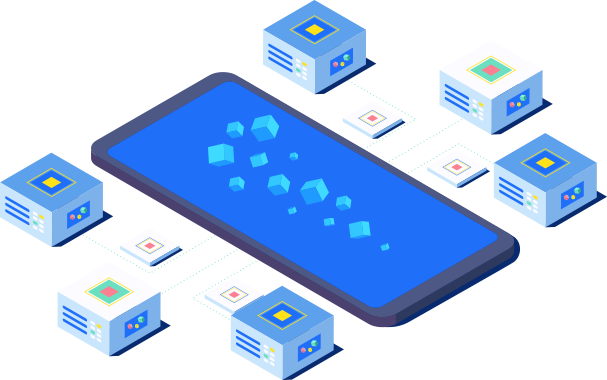
Illustration: Hosting for AI Chatbots: Server Requirements ExplainedOpenAI API vs Self-Hosted LLM: The Hosting Cost and Latency Tradeoff
The decision between calling an external LLM API and self-hosting a model on your own infrastructure is the single most consequential hosting choice for AI chatbot deployments, and it is not simply a matter of comparing per-token pricing against per-GPU-hour rates. The tradeoff spans cost structure, latency characteristics, data privacy, customization capability, and operational burden—five dimensions that interact in ways that make spreadsheet-level cost comparisons dangerously incomplete. The right answer depends on your chatbot's traffic volume, latency sensitivity, regulatory environment, and the specific capabilities your use case demands.
Cost Structure: Variable vs Fixed
API-dependent architectures have a fundamentally variable cost structure: every conversation costs money, and the monthly hosting bill scales almost linearly with chatbot usage. At current 2026 pricing, GPT-4o costs approximately $2.50 per million input tokens and $10.00 per million output tokens, while more affordable models like GPT-4o-mini and Claude 3.5 Haiku price at $0.15-$0.25 per million input tokens and $0.60-$1.25 per million output tokens. A typical customer support conversation of 10 back-and-forth exchanges averaging 200 tokens per direction consumes roughly 4,000 tokens and costs $0.01-$0.04 with the affordable models. Multiplied by 1,000 conversations per day, the daily API cost reaches $10-$40, or $300-$1,200 per month. This variable cost is advantageous at low usage—you pay nothing when the chatbot is idle—but becomes economically unfavorable at high, sustained volumes. Self-hosted architectures, by contrast, have a predominantly fixed cost structure: the GPU server costs $1,100-$4,500 per month whether it serves one conversation or one hundred thousand. At low usage, self-hosting is vastly more expensive per conversation. At high usage, the fixed GPU cost is amortized across so many interactions that the per-conversation cost drops below API pricing. The crossover point, based on Hosting Captain's analysis of production chatbot deployments, is approximately 1,500-3,000 LLM-escalated conversations per day for a quantized 8B-parameter model on an L40S GPU. Below that volume, API-dependent architectures are cheaper. Above it, self-hosting wins on pure infrastructure cost—though operational labor costs for maintaining GPU infrastructure must also be factored in.
Latency and User Experience
Latency—the time between when a user sends a message and when the first response token appears—is the dimension where hosting decisions most directly impact perceived chatbot quality. API-dependent architectures introduce an additional network round-trip to the AI provider's data center, which adds 20-80 milliseconds of latency for providers with nearby regional endpoints and 100-300 milliseconds when the nearest API endpoint is on a different continent. Self-hosted architectures eliminate this round-trip entirely: the backend server, inference engine, and model weights all reside within the same data center or even the same physical machine, reducing the non-inference component of latency to sub-millisecond intra-machine communication. For a chatbot hosted in Mumbai calling an OpenAI API endpoint in the United States, the network latency alone can exceed 200 milliseconds—perceptible as sluggishness in the chat interface—while a self-hosted model in a Mumbai data center delivers response streaming in under 10 milliseconds of network overhead. Geographic hosting location, therefore, matters disproportionately for API-dependent chatbots, and selecting an AI provider with regional API endpoints in your target geography is a hosting decision that directly affects user experience. The W3C web standards for real-time communication protocols like WebSocket and Server-Sent Events provide the transport-layer foundation that makes low-latency chatbot streaming possible, and adherence to these standards ensures compatibility across browsers and network conditions.
Data Privacy, Customization, and Control
Self-hosted architectures become the only viable path when data privacy regulations mandate that conversation data never leaves your controlled infrastructure. Healthcare chatbots subject to HIPAA, financial services chatbots governed by PCI DSS or regional banking regulations, and European websites processing personal data under GDPR may find that the Data Processing Agreements and Standard Contractual Clauses offered by AI API providers are insufficient for their compliance requirements—or that the specific API endpoints offering regional data residency are priced at a 20-40% premium that narrows the cost gap with self-hosting. Self-hosting also unlocks customization capabilities that API providers may not support: fine-tuning the model on your domain-specific vocabulary and conversation patterns, implementing custom output filters and safety guardrails that run inside the inference pipeline, and optimizing model compilation (via TensorRT-LLM or vLLM) for your specific hardware and throughput targets. The trade-off for this control is operational responsibility: GPU driver compatibility, CUDA toolkit versioning, model serving framework configuration, and monitoring of GPU utilization, VRAM pressure, and thermal throttling thresholds—all of which are abstracted away by API providers but become your problem when you self-host. A dedicated GPU server requires approximately 5-15 hours per month of system administration attention for maintenance, monitoring, and incident response, a labor cost that should be factored into the build-versus-buy calculus alongside the raw infrastructure pricing.
Latency Budget: Why Hosting Location and Network Architecture Matter
Latency is the silent killer of chatbot user experience. A study published by Portent in 2024 found that conversational AI interfaces lose 1-2% of user engagement for every 100 milliseconds of additional response latency beyond the 500-millisecond threshold where interactions feel instantaneous. For an e-commerce chatbot interacting with 1,000 visitors daily, a 300-millisecond latency degradation—easily introduced by a poorly chosen hosting location—can translate to 3-6% lower engagement, directly impacting lead capture and revenue. The latency stack for an AI chatbot has four components, and hosting decisions influence every one of them.
The network latency component is the time required for data to travel between the user's browser and your backend server, and between your backend server and the LLM API (if using an external provider). The geographic distance between the user and the backend server adds approximately 1 millisecond of round-trip time per 100 kilometers of fiber distance, plus 5-15 milliseconds of routing and switching overhead. A chatbot backend hosted in Singapore serving users in New York incurs roughly 200-250 milliseconds of network latency alone, eating up half of the user's patience budget before any processing has occurred. The network latency between the backend server and the LLM API provider compounds this: a backend in Mumbai calling an OpenAI API endpoint in the United States adds another 150-250 milliseconds. Colocating the backend server, vector database, and (if self-hosting) the inference engine within the same data center region as your target users is not a marginal optimization—it is a prerequisite for delivering conversational AI that feels responsive. For chatbot deployments with a global user base, a multi-region hosting architecture with geographically distributed backend instances and a DNS-based routing layer (similar to a CDN) becomes necessary once latency measurements from distant regions exceed the 200-millisecond threshold.
The processing latency component encompasses the backend server's message handling (JSON parsing, prompt construction, context retrieval from the vector database) and the LLM inference time itself. Backend processing typically contributes 5-20 milliseconds—negligible in the overall latency budget—while LLM inference time dominates the user-visible delay. A typical LLM generates 20-60 tokens per second on a capable GPU; a 100-token response therefore requires 1.5-5 seconds of inference time. Streaming, where tokens are sent to the frontend as they are generated rather than waiting for the complete response, reduces perceived latency because the user sees the first token within 50-200 milliseconds of inference start, and the remaining tokens flow in continuously. This is why WebSocket or Server-Sent Events support is non-negotiable for production AI chatbots—HTTP polling that requests the full response after generation completes makes every interaction feel 2-5 seconds slower than a streaming implementation. Shared hosting environments that lack persistent connection support cannot deliver streaming chatbot responses, which is the technical reason (not just a policy restriction) that LLM-powered chatbots require VPS or higher hosting tiers. The W3C standards for WebSocket and Server-Sent Events protocols define the transport mechanisms that make this streaming architecture interoperable across browsers and server platforms, and adherence to these standards ensures consistent behavior for every visitor regardless of their client environment.
The vector database query latency—the time required to retrieve relevant context from your knowledge base—adds another 10-50 milliseconds when the index fits in RAM and the database is colocated with the backend server. If the vector database is hosted in a different region or if the index exceeds available RAM and spills to disk, this component can spike to 200-800 milliseconds, far exceeding its latency budget within the conversational pipeline. The hosting implication is clear: the vector database and the backend server must be in the same data center region with low-latency private network connectivity, and the vector index must fit within the provisioned RAM to avoid disk I/O during query serving. A common and cost-effective hosting topology at Hosting Captain places the backend server, Redis cache, and vector database on a single VPS (for deployments under 5 million vectors) or on colocated VPS instances within the same availability zone, minimizing all inter-service network latency to sub-millisecond levels while maintaining logical separation for maintainability.
Cost Breakdown: What You Actually Pay for AI Chatbot Hosting
Hosting for AI chatbot infrastructure is not a single line item—it is a portfolio of infrastructure and service expenses that scale differently with usage. Below, we decompose the total cost of ownership into its constituent parts and present real-world monthly cost ranges across three representative deployment profiles, based on anonymized Hosting Captain client data from 2025-2026.
Cost Component
Rule-Based (Shared Hosting)
LLM + API (VPS)
Self-Hosted LLM + RAG (GPU)
Web / Backend Server
$5–$15/month (shared)
$30–$80/month (VPS, 4vCPU/8GB)
$40–$120/month (VPS, 8vCPU/32GB)
LLM API Costs
$0
$40–$500/month (caching-dependent)
$0
GPU Instance / Server
$0
$0
$1,100–$4,500/month
Vector Database
$0
$0–$50/month (optional, for RAG)
$40–$300/month (self-hosted or managed)
Redis / Caching Layer
$0
$0–$40/month
$20–$60/month
CDN & Bandwidth
$0–$5/month
$5–$30/month
$10–$80/month
Monitoring & Observability
$0
$0–$25/month
$25–$100/month
Total Monthly Range
$5–$20
$75–$725
$1,235–$5,160
Several nuances qualify these headline numbers. The API cost range for the middle tier is wide because caching effectiveness varies dramatically: a deployment with semantic caching achieving a 65% hit rate on common support queries can reduce API spending by approximately two-thirds relative to an uncached deployment at the same traffic volume. The self-hosted GPU cost assumes 24/7 operation; for chatbots with predictable diurnal traffic patterns, scheduled scaling that powers down GPU instances during off-peak hours (e.g., 1 AM to 6 AM) can reduce the monthly GPU bill by 20-25%. At the high end of the self-hosted tier, costs assume an A100 or H100 instance serving a 70B-parameter model with high concurrency; most small to medium business deployments can achieve satisfactory performance with an L40S serving a quantized 8B-parameter model, landing at the lower end of the GPU cost range. The vector database cost also scales with data: a knowledge base of 50,000 document chunks (approximately 200,000 vectors) can run on a $40 per month VPS alongside the backend server, while a library of 50 million chunks demands dedicated infrastructure at $200-$300 per month.
For startups and budget-constrained teams, several AI hosting providers offer startup credit programs that can eliminate infrastructure costs during the critical prototyping and early-production phases. AWS Activate, Google for Startups Cloud Program, and Microsoft for Startups Founders Hub collectively distribute hundreds of millions of dollars in GPU and cloud credits annually, and a well-timed application can cover the first 3-12 months of chatbot hosting costs while product-market fit is established. Hosting Captain recommends that teams beginning their chatbot hosting journey instrument cost tracking from day one—per-conversation cost, per-API-call cost, and per-GPU-hour cost—before usage scales to the point where a cost surprise becomes a budget crisis.
Scaling Strategies: From 100 to 100,000 Conversations Per Day
A chatbot that works at development scale—five team members testing it simultaneously—bears almost no resemblance, architecturally or financially, to the same chatbot serving a production audience. The scaling path from prototype to high-volume deployment follows a predictable pattern of bottlenecks, each requiring a specific hosting infrastructure upgrade. Understanding this progression before you encounter each bottleneck is the difference between a planned capacity increase and a panicked midnight server migration.
The Concurrency Cliff: Why 50 Users Break an Unprepared Server
The first scaling bottleneck almost every chatbot deployment encounters is not total daily conversations but peak concurrent users. A chatbot serving 1,000 conversations spread evenly across 24 hours faces minimal concurrency—perhaps 5-10 simultaneous users. The same chatbot receiving those 1,000 conversations in a 2-hour burst after a product launch or promotional email faces 50-100 simultaneous users, a tenfold increase in instantaneous resource demand. The hosting resources consumed by WebSocket connections, conversation state storage, and LLM API call concurrency all scale with peak simultaneous users, not daily averages. The most common failure mode at Hosting Captain is a chatbot that performs flawlessly during development, launches smoothly, and then collapses on the first day of real traffic because the server was sized for average concurrency, not peak. The fix is straightforward but requires a hosting tier upgrade: doubling vCPU count, doubling RAM, and increasing the reverse proxy's (Nginx or Caddy) maximum connection limit to accommodate the peak WebSocket count with a 50% buffer above the highest observed concurrency during load testing.
Horizontal Scaling: Load Balancers, Redis Clusters, and Read Replicas
When a single VPS instance reaches its vertical scaling ceiling—typically around 16-32 vCPUs and 64-128 GB of RAM for cost-effective cloud instances—the scaling strategy shifts from vertical (bigger server) to horizontal (more servers). A load balancer (Nginx, HAProxy, or a cloud provider's managed load balancer) distributes incoming WebSocket connections across multiple backend instances, each running identical chatbot middleware. The conversation state, previously stored in-memory on a single server, must be externalized to a shared Redis cluster accessible to all backend instances, so that a user reconnecting after a network interruption can resume their chat session regardless of which backend instance the load balancer routes them to. The vector database, if self-hosted, may need read replicas to distribute search query load across multiple nodes—Qdrant, Milvus, and Weaviate all support multi-node topologies with query fan-out across replicas.
For API-dependent chatbots, the scaling limit is rarely the backend servers themselves—a well-optimized Node.js or Go backend can handle thousands of concurrent WebSocket connections on modest hardware—but the LLM API's rate limits and the cost of unbounded API consumption. OpenAI's usage tiers impose requests-per-minute and tokens-per-minute limits that, if hit during a traffic spike, cause API errors that degrade the chatbot experience for all users. The scaling strategy at this tier involves implementing a message queue (Redis, RabbitMQ, or BullMQ) that buffers API requests during traffic surges, applies backpressure when API rate limits are approached, and processes queued requests as capacity permits rather than failing them outright. Combined with a circuit breaker that temporarily disables LLM escalation when API error rates exceed a threshold, this architecture degrades gracefully under load rather than collapsing—users receive slightly delayed rather than outright failed responses, and the system self-recovers when the traffic spike subsides.
GPU Scaling for Self-Hosted Deployments
Self-hosted LLM chatbot deployments scale differently from API-dependent ones because the bottleneck is GPU compute throughput and VRAM capacity, not API rate limits. A single L40S GPU can serve a quantized 8B-parameter model to 10-15 concurrent users with sub-second time-to-first-token. When concurrency exceeds this threshold, the time-to-first-token degrades linearly as incoming requests queue behind active inference runs. The scaling response is to add more GPUs—either multiple GPUs within a single server (up to 4-8 GPUs per node, interconnected via NVLink for efficient tensor parallelism across larger models) or multiple GPU servers behind a load balancer, each running an independent instance of the model serving framework (vLLM, TGI, or NVIDIA Triton Inference Server). A load-balanced cluster of four L40S GPUs can serve 40-60 concurrent chatbot users with consistent latency, and the load balancer's health-check mechanism automatically routes traffic away from any GPU instance experiencing elevated inference latency due to thermal throttling or transient hardware issues.
The cost scaling of multi-GPU deployments is linear with the number of GPUs, making it critical to establish the actual concurrency demands of your chatbot audience before provisioning a cluster. Hosting Captain's benchmarking consistently shows that most small to medium business chatbots—those serving 500-2,000 daily LLM-escalated conversations—never exceed 15-20 peak concurrent users and are adequately served by a single L40S or A10G GPU instance. Teams that preemptively provision a four-GPU cluster "just in case" often discover after three months of operation that GPU utilization never exceeds 25%, meaning they are paying for three idle GPUs. The disciplined approach provisions the smallest viable GPU configuration first, instruments GPU utilization and inference queue depth exhaustively, and adds GPU capacity only when p95 time-to-first-token consistently exceeds the 500-millisecond threshold during peak hours. For broader context on how AI workloads and traditional hosting infrastructure converge at scale, our overview of agentic AI hosting examines the orchestration patterns that emerge when chatbots evolve beyond simple Q&A into autonomous agent systems that execute multi-step workflows on behalf of users.
Frequently Asked Questions
Can I run an AI chatbot on shared hosting?
Only rule-based or keyword-matching chatbots with no machine learning component can function on shared hosting. Shared hosting environments lack persistent process support (WebSocket servers, daemons), restrict software installation, and impose CPU and RAM limits that any NLP or LLM-powered chatbot will exhaust under even light concurrency. If your chatbot needs to understand natural language, classify intents, or generate AI-powered responses, the minimum viable hosting tier is a VPS with at least 4 GB of RAM and root access to install required software packages and run persistent services. For a comprehensive introduction to virtual private server capabilities, our VPS hosting guide explains the resource isolation, root access, and persistent process support that differentiate VPS environments from shared hosting and make them the foundation for production AI chatbot deployments.
How much does hosting for AI chatbot deployments cost per month?
Total monthly costs span from $5 for a simple rule-based chatbot on shared hosting to $5,000+ for a self-hosted LLM with retrieval-augmented generation on multi-GPU infrastructure. The most common deployment profile—an API-dependent LLM chatbot on a VPS with caching—costs $75-$250 per month for a small to medium business handling 200-500 daily chatbot conversations. The single largest cost variable is whether you self-host the language model (paying $1,100-$4,500 per month for GPU infrastructure regardless of usage) or call an external API (paying $0.01-$0.04 per conversation, scaling linearly with traffic). For the majority of business websites, the API-dependent path with aggressive semantic caching provides the optimal cost-to-capability ratio and avoids the operational overhead of GPU server management. The cost breakdown table in Section 5 above itemizes each infrastructure component across deployment tiers, and our AI hosting guide provides the full context on GPU pricing, commitment discounts, and the hidden costs of storage and data transfer that influence the total cost of ownership.
What server specifications do I need for an AI chatbot on my website?
Server specifications depend directly on the chatbot's AI complexity tier. A rule-based chatbot needs only a standard shared hosting plan (1-2 vCPU equivalents, 512 MB-2 GB RAM). An NLP chatbot with intent classification requires a VPS with at least 2 vCPUs and 4 GB of RAM. An LLM-powered chatbot using an external API requires a VPS with 4 vCPUs, 8 GB of RAM, and NVMe storage (for the backend server, Redis cache, and optional vector database). A self-hosted LLM requires a GPU server with at minimum an NVIDIA L40S or RTX 4090 (24-48 GB VRAM) for a quantized 8B-parameter model serving 10-15 concurrent users, or an A100/H100 for larger models and higher concurrency. The backend server, Redis cache, and vector database should be colocated in the same data center region to minimize inter-service network latency, which directly contributes to the user-visible response delay. For chatbot deployments targeting Indian audiences, hosting in a Mumbai data center reduces network latency to 5-20 milliseconds for the majority of users, versus 150-300 milliseconds when the backend is hosted in the United States or Europe.
Is it cheaper to use the OpenAI API or host my own LLM?
The economic break-even between API-dependent and self-hosted LLM architectures occurs at approximately 1,500-3,000 LLM-escalated conversations per day. Below this threshold, paying per API call is cheaper because the GPT-4o-mini or Claude 3.5 Haiku pricing of $0.01-$0.04 per conversation remains below the amortized per-conversation cost of a $1,100-$1,800 monthly GPU instance. Above this threshold, the fixed GPU cost is spread across so many conversations that the per-conversation cost drops below API rates. However, the pure infrastructure cost comparison is incomplete without accounting for operational labor—self-hosting requires 5-15 hours per month of GPU server administration, driver updates, and model serving framework maintenance, while API-dependent architectures transfer that burden to the provider. For organizations without dedicated DevOps or MLOps personnel, the managed simplicity of API-dependent chatbots often justifies the per-token premium up to significantly higher volumes than the raw infrastructure math would suggest. Our analysis of agentic AI hosting explores how these cost dynamics shift when chatbots evolve into autonomous agents that make multiple LLM calls per user interaction, multiplying the economic impact of the API-versus-self-hosted decision.
Why does chatbot hosting location matter for response speed?
Network latency between the user's browser, your backend server, and the LLM API provider adds directly to the total response time a user perceives. A chatbot backend hosted in Mumbai serving a user in Mumbai adds 5-20 milliseconds of network latency—imperceptible. The same backend hosted in Virginia adds 200-300 milliseconds—noticeably sluggish and enough to degrade user engagement measurably. If the LLM API endpoint is also distant (e.g., OpenAI's default US endpoint serving a Mumbai-hosted backend), the combined network latency can exceed 400 milliseconds before any processing begins. Colocating the backend server, vector database, and inference engine in a data center geographically close to your primary audience is not a marginal optimization for chatbot hosting—it is often the single largest determinant of perceived response quality. For global audiences, a multi-region hosting architecture with backend instances in Asia-Pacific, Europe, and North America, combined with DNS-based geographic routing, ensures that every user connects to a nearby server while all instances share a common Redis cluster and vector database for consistent conversation state.
How do I prevent my AI chatbot hosting costs from spiraling out of control?
The most effective cost-control measures for AI chatbot hosting are, in order of impact: semantic caching (storing LLM responses keyed by the meaning of the query, not the exact text, which intercepts 50-70% of common questions and reduces API costs proportionally), hard API spending caps configured in your AI provider's dashboard (OpenAI, Anthropic, and Google all support monthly budget limits that disable API access when exceeded), rate limiting at the application layer (20 messages per user session per 10-minute window prevents both abusive usage and buggy frontend code from generating runaway API costs), scheduled scaling for self-hosted GPU instances (powering down GPU servers during known low-traffic hours saves 20-25% on monthly GPU bills), and cost-attribution monitoring (logging per-conversation API cost so you can identify which pages, campaigns, or user segments are driving chatbot usage and costs). A Redis caching layer that stores LLM responses for common queries costs $0-$40 per month and often pays for itself within the first week of operation through reduced API spending. For startups, applying to cloud provider startup programs (AWS Activate, Google for Startups, Microsoft for Startups) can provide $5,000-$100,000 in GPU and cloud credits that cover chatbot hosting costs during the critical validation phase before revenue justifies the infrastructure expenditure.
What is the difference between hosting a chatbot and hosting a regular website?
The fundamental difference is that a regular website primarily serves static or database-backed content through short-lived HTTP requests, while an AI chatbot maintains persistent, stateful connections (WebSocket or Server-Sent Events) and invokes computationally intensive AI inference—either locally on a GPU or via API calls to a remote model—for every user interaction. The hosting implications cascade from this difference: chatbot hosting requires persistent process support and WebSocket capability (ruling out shared hosting), consistent RAM allocation for conversation state and model weights (ruling out burstable or oversold VPS instances), GPU hardware for self-hosted LLMs (a hardware category completely absent from traditional web hosting), and colocated vector database infrastructure for retrieval-augmented chatbots (adding a specialized data store with its own CPU, RAM, and storage requirements). The monitoring requirements also differ fundamentally: traditional web hosting monitors page load time, TTFB, and HTTP error rates, while chatbot hosting must additionally track WebSocket connection counts, per-conversation API costs, GPU utilization and VRAM pressure, inference latency percentiles, and vector database query latency—a telemetry surface area that is substantially larger and requires purpose-built observability tooling. For an introduction to the hardware and software infrastructure that supports AI workloads in production, our AI hosting fundamentals guide covers GPU servers, inference engines, and the orchestration layers that differentiate AI-ready hosting from conventional web servers.
Do I need a vector database to host an AI chatbot?
A vector database is not required for chatbots that generate responses purely from the LLM's training data—general conversational agents, creative writing assistants, or simple FAQ bots that do not need to reference your specific content. However, any chatbot that needs to answer questions about your products, documentation, policies, or internal knowledge base requires a vector database to implement retrieval-augmented generation (RAG): the process of embedding your content into vectors, indexing them in a vector database, searching for the most semantically relevant content chunks for each user query, and injecting those chunks as context into the LLM prompt. Without a vector database, a chatbot asked about your specific return policy will either decline to answer (because the LLM has no knowledge of your business) or hallucinate a plausible-sounding but incorrect response—damaging trust and creating liability. The vector database is the component that turns a generic language model into a knowledgeable business assistant, and its hosting requirements—RAM for the search index, NVMe storage for vector persistence, and colocation with the backend server for low query latency—must be factored into the overall chatbot hosting architecture from the planning stage. Our dedicated guide to vector database hosting compares the five major options (Pinecone, Qdrant, Milvus, pgvector, and Weaviate) with cost breakdowns and deployment patterns for every scale tier.
Arjun Mehta is a cloud infrastructure consultant specializing in bare-metal architectures, network routing, and high-traffic database clustering.
Frequently Asked Questions
This guide covers the practical decision points — pricing, performance, and when it makes sense for your situation — based on current 2026 data.
Pricing varies by provider and plan tier; see the cost breakdown section above for current ranges and what's actually included at each price point.
Look closely at uptime guarantees, renewal pricing (not just the first-year discount), and how responsive support actually is — all covered in detail in this article.
Hosting Captain has been exceptional for my e-commerce store in Pune. The NVMe SSD speed is
noticeable, and their support team responds within minutes. Highly recommended for any
Indian business!
Ryan John, Pune
Great Value for Money
Switched from a US-based host to Hosting Captain and my website loads 3x faster for Indian
visitors. The free SSL and cPanel are great, and the pricing is unbeatable. Very satisfied
customer!
Priya Mehta, Mumbai
Reliable VPS Hosting
I've been using their VPS plan for 2 years now. 99.9% uptime is not just a claim — it's
reality. My client projects run without interruption. The KVM virtualization gives me full
control I need.
Amit Kumar, Bangalore
Excellent 24/7 Support
The support team helped me migrate my entire WordPress site at 2 AM without any downtime.
This level of service is rare in Indian hosting. Worth every rupee!
Sunita Patel, Ahmedabad
Perfect for Startups
As a startup, budget matters. Hosting Captain's Business plan covers everything we need —
multiple websites, free SSL, daily backups — at a fraction of what international hosts
charge.
Vikram Singh, Delhi
Professional Dedicated Server
Our high-traffic news portal needed a dedicated server. Hosting Captain's DS Business plan
handles 100K+ daily visitors effortlessly. Their team provisioned everything within 4 hours!
Meena Krishnaswamy, Chennai
Trusted Technologies & Partners
Start Your Website with Hosting Captain
From personal blogs to enterprise solutions, we've got you covered!