The question of how much server power you need to run a local LLM has become one of the most frequently asked infrastructure questions of 2026, and the answers circulating online range from dangerously optimistic to unnecessarily pessimistic. You will find forum posts claiming that a Raspberry Pi can run a 7-billion-parameter model at conversational speed — it cannot, not even close — alongside vendor whitepapers suggesting that anything less than an 8-GPU H100 cluster is inadequate for production deployment — which is equally misleading for the majority of real-world use cases. The truth occupies a wide middle ground that depends on four interdependent variables: the model size you intend to run, the inference speed your application requires, the number of concurrent users or requests you need to serve, and whether you are performing inference only or also fine-tuning. At HostingCaptain, we have benchmarked dozens of LLM configurations across consumer, prosumer, and enterprise hardware, and the consistent finding is that matching server hardware to LLM workload requirements is a solvable engineering problem — but only when you understand what each component of server power actually contributes to model performance. This article provides a systematic framework for determining your hardware requirements, from the minimum viable configuration for experimentation to the enterprise-grade infrastructure required for production inference serving at scale.
Before diving into hardware specifications, it is worth establishing a clear definition of what "running a local LLM" actually means, because the phrase encompasses a spectrum of activities with dramatically different hardware implications. At the lightest end of the spectrum is running a quantized small model — 1 billion to 3 billion parameters, compressed to 4-bit or 8-bit precision — on consumer hardware for personal experimentation, which can be accomplished on a gaming PC with a mid-range GPU. At the heaviest end is serving a 70-billion-parameter model at full FP16 precision to hundreds of concurrent users with sub-200-millisecond latency, which requires enterprise GPU clusters with specialized interconnects and dedicated inference serving infrastructure. Between these extremes lie the configurations that most practitioners actually need: running a 7B or 13B model for a small team's internal tool, fine-tuning a model on proprietary data for domain-specific use cases, or serving inference for a production feature with modest concurrent user counts. Each of these use cases maps to a different hardware requirement profile, and understanding the mapping — rather than memorizing specification sheets — is what enables confident infrastructure decisions. For context on how these local deployment considerations fit into the broader AI hosting landscape, our comprehensive guide to AI hosting covers the GPU architectures, cloud-versus-on-premise trade-offs, and provider ecosystem. For readers interested in how AI infrastructure is transforming the hosting industry itself, our analysis of how AI is changing web hosting infrastructure provides strategic perspective.
The Four Variables That Determine Your LLM Server Requirements
Every hardware requirement for local LLM deployment can be traced back to four variables, and understanding how they interact is the foundation of accurate capacity planning. The first variable is model parameter count, which directly determines memory requirements: each billion parameters at FP16 precision occupies approximately 2 GB of GPU memory, so a 7B-parameter model requires roughly 14 GB of VRAM at full precision, a 13B model requires 26 GB, a 34B model requires 68 GB, and a 70B model requires approximately 140 GB. Quantization — reducing parameter precision from 16-bit to 8-bit, 4-bit, or even 2-bit — reduces these requirements proportionally, typically with a modest accuracy trade-off that is acceptable for many applications but unacceptable for others. The second variable is inference speed, measured in tokens per second, which depends primarily on GPU memory bandwidth — the rate at which the GPU can read model parameters from VRAM — rather than raw compute throughput. This is a critical and frequently misunderstood point: LLM inference is bottlenecked by memory bandwidth, not by floating-point compute capacity, because each token generation requires reading every model parameter from memory. A GPU with 900 GB/s of memory bandwidth will generate tokens roughly twice as fast as a GPU with 450 GB/s, all else being equal, even if the two GPUs have identical teraflop ratings. The third variable is concurrency — the number of simultaneous inference requests or chat sessions the server must handle — which determines whether a single GPU suffices or whether multiple GPUs with model replication are required. The fourth variable is whether fine-tuning is part of the workload, because fine-tuning requires storing not just the model parameters but also the optimizer states and gradients, which multiply the memory requirement by roughly 3x to 4x compared to inference alone.
The interaction between these variables is multiplicative, not additive. A 70B model at FP16 with a target of 50 tokens per second and 10 concurrent users is not simply "10% harder" than a 7B model for a single user — it is mathematically in a different category of hardware requirement, because the memory capacity must accommodate the full 140 GB model per GPU, the memory bandwidth must deliver sufficient throughput per concurrent user, and the total system must scale horizontally if a single GPU cannot meet the combined throughput requirement. Failure to account for these multiplicative interactions is the most common source of under-provisioned LLM deployments, and it is a mistake that manifests as unacceptable latency in production rather than as a clean error message during testing. Standards organizations like the W3C are beginning to document the infrastructure implications of AI workloads for web standards, though practical guidance for LLM deployment currently comes more from practitioner communities and hardware vendor documentation than from formal standards bodies. For readers considering edge deployment scenarios, our guide to edge AI hosting covers the latency and bandwidth considerations of running models closer to end users.
GPU Memory: The Binding Constraint for Local LLM Deployment
GPU memory capacity — VRAM — is the single constraint that determines whether a given LLM can run on a given server at all, and it is the hardware specification that should drive the initial hardware selection process before any other consideration. A model that does not fit in available VRAM cannot be served without offloading layers to system RAM (dramatically slower, often reducing throughput by 90% or more) or splitting the model across multiple GPUs using tensor parallelism (requiring NVLink or equivalent high-bandwidth interconnects between GPUs). The memory formulas are straightforward: at FP16 precision, a model with P billion parameters requires approximately 2 × P GB of VRAM for the parameters themselves, plus approximately 1-2 GB of additional VRAM for the key-value cache that stores attention states during generation — with the cache size scaling with the maximum context length and the batch size. For a 7B-parameter model, this means roughly 16 GB of VRAM for FP16 inference, or approximately 8 GB at 8-bit quantization and roughly 5 GB at 4-bit quantization. For a 13B model, the numbers double to roughly 28 GB at FP16, 14 GB at 8-bit, and 8 GB at 4-bit. For a 70B model, FP16 inference requires approximately 140 GB of VRAM, which means at least two 80 GB GPUs (such as the NVIDIA A100 or H100) with tensor parallelism enabled, or four 48 GB GPUs (such as the L40S or RTX 6000 Ada) working in parallel.
The practical implications of these VRAM requirements for hardware selection in mid-2026 are fairly clear. For running 7B models at 4-bit quantization — which preserves approximately 95% to 97% of the FP16 model's accuracy for most benchmarks and is adequate for many summarization, classification, and chat use cases — a single NVIDIA RTX 3060 with 12 GB of VRAM, an RTX 4060 Ti with 16 GB, or a used RTX 3090 with 24 GB are all viable options at consumer price points ranging from $300 to $900. For 13B models at 4-bit, 16 GB of VRAM is the practical minimum, making the RTX 4060 Ti 16 GB or a used RTX 3090 the entry point, while 8-bit 13B models require at least 24 GB — putting the RTX 3090, RTX 4090, or a single A4000 workstation GPU as the hardware floor. For 34B models, even at 4-bit precision, approximately 20 GB of VRAM is needed — placing these models firmly in the territory of the RTX 3090 or 4090 (24 GB) for minimum viable inference, with the RTX 6000 Ada (48 GB) providing comfortable headroom. For 70B models, the hardware requirements jump into enterprise territory: 4-bit quantization brings the memory requirement to approximately 40 GB, which fits on a single RTX 6000 Ada (48 GB) or an A6000, but at throughput levels that may not support multiple concurrent users. FP16 or 8-bit 70B inference genuinely requires multi-GPU configurations — two RTX 6000 Ada GPUs, two A100 80 GB GPUs, or a single H100 80 GB with CPU offloading that will constrain throughput.
For readers who are evaluating these requirements against the foundational hosting platforms that support them, our complete beginner's guide to VPS hosting explains the virtualization and resource allocation concepts that underpin both traditional and AI hosting environments, establishing the vocabulary for understanding how GPU resources are provisioned and isolated in shared infrastructure settings.
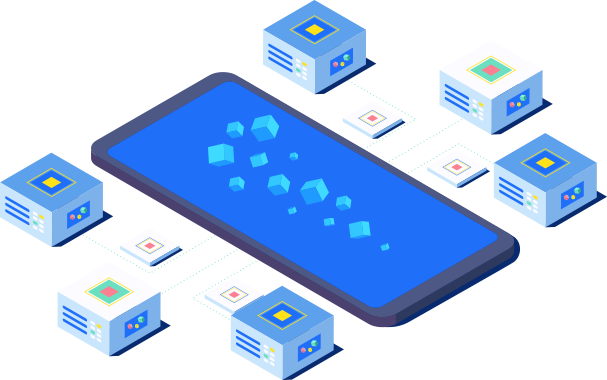
Illustration: How Much Server Power Do You Need to Run a Local LLM?Memory Bandwidth, Compute Throughput, and Inference Speed
Once the VRAM capacity question is answered — meaning you have confirmed that the model fits — the next constraint that determines performance is GPU memory bandwidth, which governs how fast tokens can be generated. LLM inference is an autoregressive process: the model generates one token at a time, and each token generation requires reading the entire set of model parameters from VRAM into the GPU's compute units. This makes memory bandwidth the dominant performance factor, not teraflops. A GPU with 900 GB/s of memory bandwidth can theoretically read and process parameters at a maximum rate of 900 GB ÷ 2 bytes per parameter (at FP16) = 450 billion parameters per second. If the model has 7 billion parameters, the theoretical maximum token generation rate is 450 ÷ 7 ≈ 64 tokens per second — a respectable speed for interactive chat. In practice, achievable throughput is lower due to attention computation overhead, KV cache management, and software stack inefficiencies, with real-world throughput typically falling between 50% and 70% of the theoretical bandwidth limit.
To make this concrete with 2026 GPU specifications: an NVIDIA RTX 3060 (12 GB, 360 GB/s bandwidth) can run a 7B 4-bit model at approximately 30 to 45 tokens per second — perfectly usable for a single user's chat interface. An RTX 3090 (24 GB, 936 GB/s) can run the same model at 70 to 90 tokens per second and can handle a 13B 4-bit model at 35 to 50 tokens per second. An RTX 4090 (24 GB, 1,008 GB/s) pushes 7B model throughput to 80 to 100 tokens per second and 13B 4-bit to 45 to 60 tokens per second. In the enterprise GPU tier, an NVIDIA A100 80 GB (2,039 GB/s bandwidth) can serve a 70B 4-bit model at approximately 25 to 40 tokens per second, while an H100 80 GB (3,350 GB/s) can push the same configuration to 40 to 65 tokens per second. These are single-user, single-request throughput numbers; serving multiple concurrent users divides the available bandwidth across the active requests, so an H100 that generates 50 tokens per second for one user will generate 25 tokens per second each for two concurrent users, 12.5 for four, and so on — assuming the model fits in VRAM and the KV cache does not overflow.
Compute throughput — measured in teraflops — becomes relevant when batch processing is involved: serving multiple inference requests simultaneously through batching, which increases GPU utilization by processing several requests' matrix multiplications concurrently rather than sequentially. Batching improves throughput linearly up to the point where VRAM becomes the constraint — because the KV cache for each concurrent request consumes additional memory — and then stops scaling. This is why inference serving infrastructure like vLLM and NVIDIA Triton Inference Server implements continuous batching, which dynamically packs incoming requests into batches to maximize throughput without exceeding VRAM limits. For deployment scenarios where throughput matters more than per-request latency — batch processing of documents through an LLM for summarization or classification — compute throughput and batching efficiency become the primary performance metrics, while for interactive chat applications, memory bandwidth and per-request latency dominate.
CPU, System RAM, and Storage: The Supporting Infrastructure
While the GPU dominates attention in LLM hardware discussions, the supporting infrastructure — CPU, system RAM, storage, and networking — can create bottlenecks that undermine the investment in GPU hardware if not properly provisioned. The CPU's primary role in an LLM inference server is data preprocessing and I/O management: tokenizing input text, managing the data pipeline that feeds prompts to the GPU, handling network I/O for API requests, and coordinating multi-GPU communication. A modern server-class CPU — Intel Xeon Scalable 4th or 5th generation, AMD EPYC 9004 or 9005 series — with 16 to 32 cores is more than adequate for feeding data to even an 8-GPU inference server, and for single-GPU deployments, a consumer-grade CPU like an Intel Core i7 or AMD Ryzen 7 with 8 to 16 cores is entirely sufficient. The CPU is rarely the bottleneck in LLM inference; GPU memory bandwidth and VRAM capacity are the constraints, and over-investing in CPU cores for an inference server is a common misallocation of hardware budget.
System RAM serves two functions in an LLM server: it supports the operating system, the inference serving software, and any data preprocessing pipelines that run on the CPU, and — critically — it serves as an overflow buffer when model layers must be offloaded from GPU VRAM. The baseline system RAM requirement is approximately 32 GB to 64 GB for a single-GPU inference server, enough to support the operating system and the model serving framework without swapping. For multi-GPU servers, 128 GB to 256 GB of system RAM is typical, and for configurations where model layers are partially offloaded to CPU memory — a strategy that allows running models larger than individual GPU VRAM capacity, at a substantial throughput penalty — system RAM capacity should exceed the total model size by at least 50%. Storage performance matters primarily during model loading: a large model checkpoint stored on a SATA SSD may take 60 to 120 seconds to load into GPU memory, while the same checkpoint on an NVMe SSD loads in 10 to 20 seconds — a difference that matters for deployment scenarios where models are swapped frequently or where cold-start latency is a service-level concern. For continuous inference serving where the model remains resident in GPU memory, storage performance after the initial load is largely irrelevant, and even a SATA SSD provides adequate performance for the logging, configuration, and model file storage that constitutes the ongoing storage workload.
Fine-Tuning: The Memory Multiplier That Changes Everything
Fine-tuning an LLM — whether full fine-tuning, parameter-efficient fine-tuning with LoRA adapters, or continued pre-training on domain-specific data — imposes hardware requirements that are qualitatively different from inference requirements, and anyone planning to both train and serve LLMs on local hardware must understand the difference. During fine-tuning, the GPU must store not just the model parameters but also the optimizer states (typically AdamW, which requires two additional parameter-sized buffers for the first and second moment estimates), the gradients for each parameter, and the activations from the forward pass that are needed for the backward pass. The total memory requirement for fine-tuning a model with P billion parameters at FP16 precision is approximately 2 × P GB (parameters) + 4 × P GB (optimizer states) + 2 × P GB (gradients) + activation memory, for a total of roughly 10 to 14 × P GB before activation memory. A 7B model that requires 14 GB for inference requires approximately 70 to 98 GB for full fine-tuning — a 5x to 7x multiplier that pushes even small models into multi-GPU territory. A 70B model that requires 140 GB for inference demands roughly 700 to 980 GB for full fine-tuning, which means an 8-GPU H100 cluster with 80 GB per GPU (640 GB total) is still insufficient for full fine-tuning without model parallelism and gradient checkpointing strategies that trade compute for memory.
Parameter-efficient fine-tuning methods — primarily LoRA (Low-Rank Adaptation) and its variants — dramatically reduce the memory burden by freezing the pre-trained model weights and training only a small set of adapter parameters, typically representing 0.1% to 1% of the total parameter count. LoRA fine-tuning of a 7B model can be done on a single RTX 3090 or 4090 with 24 GB of VRAM, and LoRA fine-tuning of a 70B model is feasible on a single A100 80 GB or a pair of 48 GB GPUs — configurations that are one to two orders of magnitude less expensive than the hardware required for full fine-tuning. The trade-off is that LoRA adapters may not match the performance of full fine-tuning for tasks that require substantial knowledge acquisition or fundamental behavior changes, though for domain adaptation, instruction tuning, and style transfer — which are the most common fine-tuning use cases in practice — LoRA achieves 90% to 98% of full fine-tuning quality at a fraction of the hardware cost. For most organizations deploying local LLMs, LoRA fine-tuning on a single high-end consumer GPU or entry-level workstation GPU represents the optimal balance of capability and cost, and it is the approach that HostingCaptain recommends for teams evaluating their first fine-tuning project.
Real-World Configurations by Use Case
Mapping the hardware analysis above to specific use cases produces the following recommended configurations, based on mid-2026 hardware pricing and availability. For personal experimentation and development — running 7B models for chat, code completion, or document summarization with a single user — a consumer desktop with an RTX 3060 12 GB ($300), RTX 4060 Ti 16 GB ($500), or used RTX 3090 24 GB ($600-$800) paired with 32 GB of DDR5 system RAM and a 1 TB NVMe SSD is the optimal starting point. This configuration runs 7B models at 4-bit with 30 to 90 tokens per second depending on the GPU, can experiment with 13B models at 4-bit on the 16 GB or 24 GB cards, and supports LoRA fine-tuning of 7B models. Total system cost ranges from $1,000 to $2,000 depending on component selection, making it accessible to individual developers and small teams.
For small-team deployment — serving a 7B to 13B model to 5 to 20 internal users for document Q&A, code assistance, or content drafting — a workstation-class build around an RTX 4090 24 GB ($1,600-$1,800) or an RTX 6000 Ada 48 GB ($4,000-$5,000) with 64 GB of system RAM, a high-core-count CPU (Intel Core i9 or AMD Ryzen 9), and redundant NVMe storage provides headroom for multiple concurrent users, LoRA fine-tuning, and model experimentation. The RTX 4090 handles 13B 4-bit models at interactive speeds for 3 to 5 concurrent users; the RTX 6000 Ada extends that to 8 to 12 concurrent users and accommodates 34B 4-bit models. Total system cost ranges from $4,000 to $8,000, which for a team of 10 people represents a per-user cost of $400 to $800 — competitive with API-based LLM services when usage exceeds a few hundred thousand tokens per day. HostingCaptain's infrastructure consulting team has helped numerous small businesses configure and deploy precisely these workstation-class LLM servers, and the consistent feedback is that the upfront hardware investment pays for itself within 6 to 12 months compared to API costs for moderate-to-heavy usage patterns.
For production inference serving — deploying a 34B to 70B model to hundreds of concurrent users with latency guarantees — the hardware requirements enter the enterprise server domain. A 70B model at 4-bit precision on a single H100 80 GB GPU with 3,350 GB/s memory bandwidth can serve approximately 40 to 65 tokens per second for a single request, or approximately 10 to 15 concurrent users at reasonable interactive speeds. Scaling to hundreds of concurrent users requires model replication across multiple GPUs — four H100 GPUs each holding a copy of the model, with a load balancer distributing requests — at a total hardware cost of $120,000 to $180,000 for the GPU server, plus networking, storage, and infrastructure. At this scale, the economic comparison between on-premise deployment and cloud GPU rental becomes the central decision, with cloud rental typically being more cost-effective for variable or growing workloads and on-premise deployment being more cost-effective for sustained, predictable utilization above approximately 50% to 60%. Organizations operating at this scale should evaluate both paths with detailed total-cost-of-ownership models that account for power, cooling, networking, and operational labor — not just the GPU hardware purchase price.
Software Stack Considerations: The Hidden Complexity Factor
The hardware specifications described above assume that the software stack — the inference engine, the model serving framework, the tokenizer, and the API layer — is configured correctly and efficiently. In practice, software stack choices can reduce effective throughput by 30% to 50% compared to optimally configured alternatives, which means that software selection and tuning are as important as hardware selection for achieving target performance. The current leading inference engines in mid-2026 are llama.cpp (optimized for consumer GPUs and CPU inference, with excellent quantization support), vLLM (optimized for high-throughput serving with continuous batching and PagedAttention for efficient KV cache management), NVIDIA Triton Inference Server (enterprise-grade serving with support for multiple model frameworks, dynamic batching, and GPU sharing through Multi-Instance GPU partitioning), and Hugging Face's Text Generation Inference (a production-focused serving framework with built-in quantization, watermarking, and API compatibility).
The choice between these frameworks depends on the deployment context. For single-user experimentation and development on consumer GPUs, llama.cpp with its GGUF quantized model format is the most accessible and resource-efficient option, requiring no CUDA toolkit installation and supporting a wide range of quantization levels from 2-bit to 8-bit. For small-team serving, vLLM provides the best combination of performance, ease of deployment, and API compatibility with the OpenAI chat completions format — allowing existing applications built against the OpenAI API to switch to a local LLM by changing only the base URL. For enterprise production deployments with uptime requirements and multi-tenancy, NVIDIA Triton Inference Server provides the most robust feature set, including model versioning, canary deployments, metrics export to Prometheus, and integration with Kubernetes for orchestrated deployment. HostingCaptain's experience deploying LLM infrastructure for clients across all three contexts has demonstrated that the software stack selection should be made early in the planning process — before hardware purchasing — because the stack's memory overhead, batching behavior, and GPU compatibility directly affect the hardware requirements.
Frequently Asked Questions
What is the minimum server power required to run a local LLM?
The absolute minimum for running a usable local LLM in mid-2026 is a system with a GPU that has at least 8 GB of VRAM — such as an NVIDIA RTX 3060 12 GB, RTX 4060 8 GB, or an AMD Radeon RX 7600 XT 16 GB — paired with 16 GB of system RAM. This configuration can run 7B-parameter models at 4-bit quantization (approximately 5 GB VRAM usage) at 15 to 30 tokens per second, which is adequate for personal experimentation and single-user chat. Note that 8 GB VRAM configurations leave minimal headroom for context length and may require aggressive quantization; 12 GB or more is strongly recommended for a practical development experience without constant memory management. Below 8 GB of VRAM, LLM inference is possible through CPU-only execution with llama.cpp, but throughput drops to 2 to 5 tokens per second for 7B models — usable for batch processing but frustrating for interactive use.
Can I run an LLM on a CPU-only server without a GPU?
Yes, CPU-only LLM inference is possible through frameworks like llama.cpp that use CPU SIMD instructions (AVX2, AVX-512) and memory bandwidth optimization to run quantized models on system RAM. A modern server with 16 to 32 cores and high-bandwidth DDR5 memory (eight memory channels on EPYC platforms) can achieve 5 to 10 tokens per second for 7B 4-bit models — usable for batch processing, code completion, and non-interactive applications. However, CPU inference throughput is typically 5x to 20x slower than GPU inference for equivalent models, and the latency makes interactive chat impractical for models above approximately 13B parameters. CPU-only deployment is most viable for offline batch processing, embedded applications, and scenarios where GPU hardware is unavailable or prohibited by cost — but for interactive LLM applications, a GPU is effectively a requirement.
How much does server hardware for a production LLM deployment cost?
Production LLM deployment costs in mid-2026 range from approximately $4,000 to $8,000 for a small-team server built around a single RTX 4090 or RTX 6000 Ada serving 5 to 20 concurrent users with 7B to 13B models, to $40,000 to $80,000 for a mid-range deployment using two to four A100 or L40S GPUs serving 50 to 200 concurrent users with 34B to 70B models, to $150,000 to $300,000 for enterprise-scale deployments with eight H100 GPUs, InfiniBand networking, and redundant infrastructure. Cloud GPU rental alternatives range from $0.80 to $1.50 per hour for L40S instances to $3.00 to $4.50 per hour for H100 instances, and the break-even point between cloud and on-premise deployment typically occurs at approximately 50% to 60% sustained utilization over a three-year period. The right choice depends on workload predictability, capital availability, and operational maturity — factors that HostingCaptain's infrastructure consulting team evaluates with clients before recommending a deployment strategy.
Does the server power requirement change if I use API-based LLMs instead of local deployment?
Using API-based LLMs — OpenAI, Google Gemini, Anthropic Claude, or open-source models hosted through services like Together AI or Fireworks — eliminates the server hardware requirement entirely from the client side. The API provider manages the GPU infrastructure, and your application server only needs sufficient resources to make HTTP requests and process API responses — typically a modest VPS or shared hosting plan, with 2 vCPUs and 4 GB of RAM being more than adequate for API integration workloads. The economic trade-off is that API costs scale with usage: at low volumes (under approximately 500,000 tokens per day), APIs are cheaper than purchasing and operating GPU hardware; at high volumes, self-hosted infrastructure becomes cost-competitive. The operational trade-off is that APIs eliminate GPU infrastructure management but introduce dependency on the API provider's uptime, pricing changes, and model availability. For most organizations, starting with APIs and transitioning to self-hosted deployment when usage justifies the hardware investment is the pragmatically optimal strategy — a pattern that our guide to AI hosting fundamentals explores in greater depth.
Arjun Mehta is a cloud infrastructure consultant specializing in bare-metal architectures, network routing, and high-traffic database clustering.
Frequently Asked Questions
This guide covers the practical decision points — pricing, performance, and when it makes sense for your situation — based on current 2026 data.
Pricing varies by provider and plan tier; see the cost breakdown section above for current ranges and what's actually included at each price point.
Look closely at uptime guarantees, renewal pricing (not just the first-year discount), and how responsive support actually is — all covered in detail in this article.
Hosting Captain has been exceptional for my e-commerce store in Pune. The NVMe SSD speed is
noticeable, and their support team responds within minutes. Highly recommended for any
Indian business!
Ryan John, Pune
Great Value for Money
Switched from a US-based host to Hosting Captain and my website loads 3x faster for Indian
visitors. The free SSL and cPanel are great, and the pricing is unbeatable. Very satisfied
customer!
Priya Mehta, Mumbai
Reliable VPS Hosting
I've been using their VPS plan for 2 years now. 99.9% uptime is not just a claim — it's
reality. My client projects run without interruption. The KVM virtualization gives me full
control I need.
Amit Kumar, Bangalore
Excellent 24/7 Support
The support team helped me migrate my entire WordPress site at 2 AM without any downtime.
This level of service is rare in Indian hosting. Worth every rupee!
Sunita Patel, Ahmedabad
Perfect for Startups
As a startup, budget matters. Hosting Captain's Business plan covers everything we need —
multiple websites, free SSL, daily backups — at a fraction of what international hosts
charge.
Vikram Singh, Delhi
Professional Dedicated Server
Our high-traffic news portal needed a dedicated server. Hosting Captain's DS Business plan
handles 100K+ daily visitors effortlessly. Their team provisioned everything within 4 hours!
Meena Krishnaswamy, Chennai
Trusted Technologies & Partners
Start Your Website with Hosting Captain
From personal blogs to enterprise solutions, we've got you covered!